





























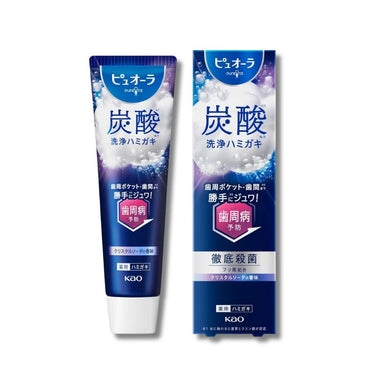


Quasi-drug Pyuora Carbonated Toothpaste
Dense carbonated foam spreads quickly into gaps, purifying the entire mouth.
For those concerned about stickiness and bacterial troubles in the mouth
"Quasi-drug Pyuora Carbonated Toothpaste" is a new style of toothpaste that cleans with "foam" instead of paste. The dense carbonated foam that comes out just by pressing the pump instantly spreads into gaps between teeth and on the tongue, washing away all dirt along with bacteria.
Because active ingredients reach even hard-to-brush areas, it efficiently prevents troubles caused by bacteria such as stickiness, bad breath, and gingivitis. Chosen by those who want to reset their mouth with unprecedented "foam penetration" and "overwhelming cleanliness."
Four Key Points
Penetration power of high-concentration carbonated foam
Carbon dioxide gas (propellant)Fine carbonated foam quickly delivers active ingredients deep into gaps between teeth that are hard to reach with a toothbrush.
Thoroughly kills causative bacteria
Bactericidal ingredient CPCBactericidal ingredient CPC (cetylpyridinium chloride) thoroughly kills bacteria that cause bad breath and gingivitis.
Complete oral purification
Cleansing agent erythritolThe cleansing agent erythritol quickly penetrates bacterial clumps (plaque). It disperses and helps wash them away.
Prevents inflammation and cares for gums
Anti-inflammatory ingredient GK2Dipotassium glycyrrhizinate (GK2) suppresses gum inflammation and prevents gingivitis.
Active Ingredients and Their Roles
| Active Ingredients | Role |
|---|---|
| Cetylpyridinium chloride (CPC) | Prevents bad breath, gingivitis, and cavities through bactericidal action. |
| Dipotassium glycyrrhizinate (GK2) | Suppresses gum inflammation and prevents gingivitis. |
| Sodium monofluorophosphate | Fluoride strengthens tooth enamel and prevents the occurrence and progression of cavities. |
Efficacy and Effects


This is amazing!


Pyuora Carbonated Toothpaste
Fizzes *2 even between teeth!
Fine carbonated *1 foam


▼

Pyuora Carbonated Toothpaste
Cleanses every corner of the mouth!

▼

Thorough sterilization! Contains bactericidal ingredient CPC Pyuora Carbonated Toothpaste
the foam itself is fine and penetrates into gaps feeling!
The abundant foam volume refreshes the entire mouth.
(Gingivitis and periodontitis)


Directions for Use and Dosage
Apply an appropriate amount (about 1.5 cm) to the toothbrush and brush your teeth and gums.
If you use the toothbrush without wetting it with water, the foam stays denser and spreads better inside the mouth.
Frequently Asked Questions
A. The power of carbon dioxide causes the foam itself to spread throughout the mouth. It efficiently cleans areas that are hard to reach with a toothbrush.
A. Yes, you can use it daily as a regular toothpaste (morning, evening, etc.). It also contains fluoride, making it suitable for cavity prevention.
🌱 Brand Story
Pyuora was born from Kao's long-standing oral care research, focusing thoroughly on the "clean feeling in the mouth." It aims not only to remove dirt but also to eliminate the "stickiness" that becomes a breeding ground for bacteria, restoring the natural healthy oral environment.
The strong concept of "purifying completely along with bacteria" exists to make self-care more reliable for busy modern people. Pyuora will continue to support health starting from the mouth with advanced technology.
⚠️ Usage Precautions
● Do not use if you have wounds or other injuries.
● Be careful not to get toothpaste in your eyes. If it gets in your eyes, rinse thoroughly without rubbing immediately, and consult an ophthalmologist if abnormalities persist.
● If you experience abnormalities in the mouth, rash, itching, severe coughing, or other symptoms, stop use and consult a doctor.
📦 Storage Precautions
● Keep out of reach of children.
● Store away from direct sunlight and high temperatures.
● Please make sure to close the cap tightly after use.


